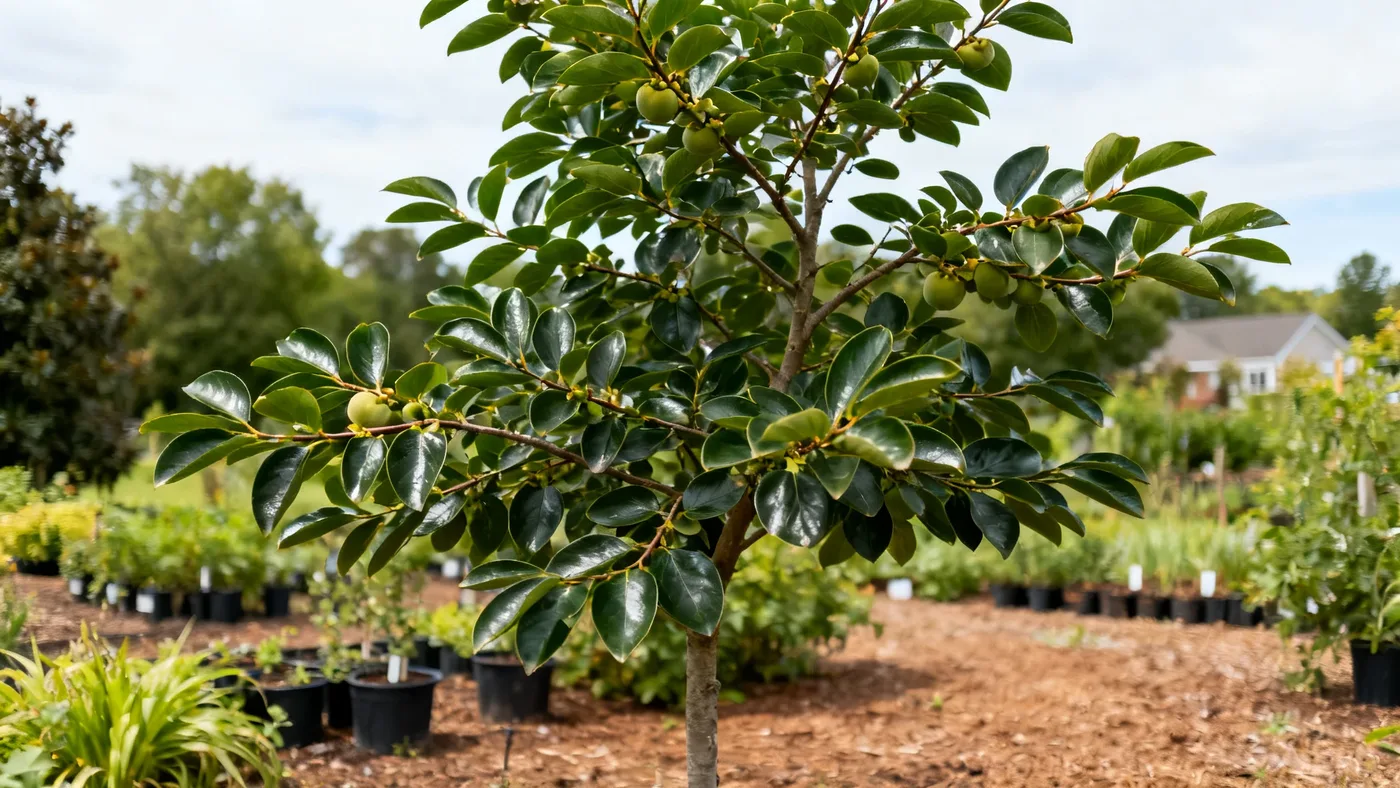
American Persimmon Care Guide: Sun, Soil, Water and Pruning Basics
- American Persimmon thrives in full sun to part shade; best fruiting happens in full sun
- Adaptable to most soil types (clay, loam, sand) with a pH range of 5.5 to 7.5
- Establish deep watering initially; mature trees become drought tolerant thanks to their taproot
- Prune in late winter while dormant to build a strong central leader
- Grows 12 to 18 inches per year once established; reaches 35 to 60 feet at maturity
- Long-lived trees that commonly live 75+ years with minimal maintenance once mature
Understanding American Persimmon Growth and Hardiness
American Persimmon, known botanically as Diospyros virginiana, is a deciduous tree native to eastern and central North America. The tree is remarkably adaptable, growing across USDA zones 4 through 9. This hardiness makes it suitable for gardeners from Connecticut southward to Florida and westward through Kansas and Texas.
The species grows at a slow to moderate pace. Young established trees add roughly 12 to 18 inches of growth per year. Mature specimens typically reach 35 to 60 feet tall with a spread of 20 to 35 feet, though some wild trees have been recorded exceeding 80 feet. Plan your spacing accordingly: space trees 20 to 35 feet apart if planting multiple trees for an orchard or landscape grouping.
One of the most distinctive features is the bark. American Persimmon develops deeply furrowed, blocky bark that resembles alligator hide. This textured bark persists through winter and adds visual interest to the dormant landscape. In fall, the glossy dark green leaves shift to shades of yellow, orange, and sometimes purplish-red before dropping. Orange fruit often clings to the bare branches well into winter, creating an attractive seasonal display.
Sunlight Requirements for Optimal Growth
American Persimmon adapts to both full sun and part shade conditions. However, fruit production is noticeably better in full sun. If you're growing the tree primarily for its edible fruit, position it where it receives the maximum direct sunlight available in your garden.
In warmer zones (8 and 9), afternoon shade can be beneficial in extremely hot climates, but this is not essential. In cooler zones (4 to 6), full sun exposure helps ensure adequate warmth for both flowering and fruit maturation. A minimum of 4 to 6 hours of direct sunlight daily will support reasonable growth and flowering; 8+ hours guarantees the best fruiting performance.
Flowers appear in late spring, typically May to June. They are small, creamy white to pale yellow-green, and not showy. The flowers carry a mild, sweet fragrance that is pleasant but rarely noticed from a distance. Bees visit the flowers for pollination.
Soil Selection and Site Preparation
American Persimmon is one of the most forgiving trees when it comes to soil. The species tolerates clay, loam, and sandy soils equally well. It even adapts to poor and compacted soils that might challenge other species. Soil pH can range from 5.5 (acidic) to 7.5 (slightly alkaline), which covers most home garden soils without amendment.
Preparing the planting hole: Dig a hole as deep as the root ball and at least twice as wide. Amend heavy clay soils by mixing 25 to 30 percent compost or aged bark into the backfill soil. This improves drainage without requiring you to replace the native soil entirely. Sandy soils benefit from 2 to 3 inches of compost worked into the upper layers to increase water and nutrient retention.
Drainage is critical. American Persimmon prefers well-drained soil. While the tree tolerates average moisture, waterlogged conditions stress the roots. If your site drains poorly, either amend it heavily with compost and sand, or consider planting on a slight mound.
The tree develops a deep taproot as it matures. This taproot is why mature American Persimmons become so drought tolerant. However, young trees need consistent soil moisture during their first two growing seasons to encourage deep root development. Once the taproot establishes (year 2 onward), supplemental irrigation becomes unnecessary in most climates except during severe drought.
Planting timing: Plant bare-root dormant trees in early spring or fall. Container-grown nursery trees can be planted any time from spring through fall, though spring and early fall are preferred to allow time for root establishment before extreme temperatures.
Watering: Finding the Right Balance
New trees require more attention to watering than established ones. For the first year after planting, water deeply once per week if rainfall is sparse. Deep watering means moistening the soil 12 to 18 inches down, not just a light surface spray. Soak the root zone thoroughly, then allow the top inch of soil to dry between waterings. This rhythm encourages the roots to penetrate deeper into the earth rather than staying shallow.
In year two and beyond, mature trees become remarkably drought tolerant. Their deep taproot accesses moisture that surface-rooted trees cannot reach. Once established, American Persimmon rarely needs supplemental irrigation except during extended dry spells (more than 3 to 4 weeks without significant rainfall).
Mulch matters. Apply 2 to 3 inches of wood chip or bark mulch around the base, starting 6 inches away from the trunk. Mulch keeps the root zone cooler, reduces evaporation, and suppresses competing weeds. Refresh the mulch layer annually or when it becomes thin.
Avoid overwatering. Excess moisture, particularly in clay soils or areas with poor drainage, can lead to root stress and fungal issues. If your site stays soggy after rain, the drainage problem must be addressed before or immediately after planting.
Fertilizing for Steady Growth
American Persimmon is a light feeder. The tree does not require heavy fertilization. In early spring, a single application of a balanced, slow-release fertilizer (such as a 10-10-10 or 12-12-12 formulation) is usually sufficient.
Avoid excessive nitrogen. While nitrogen promotes leafy green growth, it can reduce fruiting. If your goal is fruit production, use restraint with nitrogen-heavy fertilizers. If the tree is growing slowly or displaying pale foliage, a light application of balanced fertilizer in spring will help. Most mature trees in established landscape soil need no supplemental fertilizer at all.
A light layer of compost worked into the soil surface in early spring provides slow-release nutrients without the risk of over-fertilizing.
Pruning and Training Your Tree
American Persimmon requires pruning only in the early years to establish a strong structure. Once mature, the tree fruits primarily on new growth and responds well to minimal pruning.
Initial pruning (years 1 to 3): Prune in late winter while the tree is fully dormant. The goal is to establish a single central leader and a balanced branching structure. Remove crossing branches, those that grow inward toward the center of the canopy, and any damaged or broken wood. Make clean cuts just outside the branch collar (the swollen area where the branch meets the trunk).
For young whip trees (unbranched single stems), let the leader grow unpruned for the first year. In year two, thin competing leaders if more than one forms, keeping the strongest, most upright one. Select three to five scaffold branches spaced evenly around the trunk at heights between 18 and 36 inches. Remove all other side growth.
Mature tree pruning: Once the tree is 4 to 5 years old and well established, pruning needs drop sharply. In late winter, remove dead, diseased, or crossing branches. Head back any branches that have become excessively long or are blocking views. Do not heavily prune; persimmons fruit on new shoots, and heavy pruning delays fruiting.
Special note on male trees: If you are growing a male tree (one that produces no fruit), pruning is purely for shape and structure. Male trees can be pruned more aggressively for ornamental purposes without concern about reducing fruit production.
Seasonal Care Calendar
| Season | Care Tasks |
|---|---|
| Early Spring | Prune dormant trees for structure and health. Apply balanced fertilizer. Refresh mulch layer. Begin regular watering if spring drought is developing. |
| Late Spring | Flowers bloom (May to June). Monitor for pests (scale, mealybugs). Water during dry spells. Young trees need 1 inch of water per week total (rain + irrigation). |
| Summer | Young trees: deep water weekly. Mature trees: water only during drought. Watch for webworms or borers; prune out affected branches if spotted. Inspect for fungal leaf spots. |
| Fall | Fruit ripens September through November. Clean up fallen fruit regularly (prevents wildlife damage and pest breeding sites). Foliage turns yellow to orange-red. No action needed unless diseased branches are visible. |
| Winter | Tree is fully dormant. Orange fruit persists on bare branches. No watering or fertilizing needed in most climates. Early winter: plan spring pruning. Late winter: prune while dormant. |
Common Care Challenges and Solutions
Fruit drops before ripening: Immature fruit drop is common, especially in the first few years and during stress (drought, cold snaps). This is the tree's natural thinning; it doesn't signal a problem. Improve watering consistency and avoid moving or damaging the tree during growing season. Mature trees produce more reliable crops.
Unripe fruit tastes terribly astringent: Persimmons are inedible until fully ripe. Unripe fruit contains high tannins that cause mouth puckering. Wait until the fruit is soft and skin color deepens to orange-brown before harvesting. Refrigeration hastens ripeness. This is not a disease; it's normal fruit physiology.
Messy fruit litter on paved surfaces: Ripe fruit falls naturally. If the tree overhangs a patio or driveway, fallen fruit becomes slippery and stains concrete. Sweep regularly, or position the tree away from hardscaping if possible. Alternatively, plant a female cultivar only if male trees are unavailable in your area, since only females produce edible fruit.
Lack of fruit on female trees: Some female cultivars require a male pollinator tree nearby for reliable fruiting. Self-fertile cultivars like 'Meader' produce fruit without a male. Grafted trees fruit sooner (3 to 5 years) than seedlings (6 to 10 years).
Deer browsing: American Persimmon has low deer resistance. Deer readily browse young foliage and eat fallen fruit. If deer pressure is high, consider fencing the young tree for the first 3 to 4 years, or plant where deer traffic is light. Once trees are large and branching is high, they are less vulnerable to browsing.
Scale insects, mealybugs, or webworms: These are occasional pests. Inspect the tree in late spring and early summer. Small infestations can be pruned out. For larger infestations, consult your local extension service for current organic or chemical options suited to your region.
Leaf spots (Cercospora), powdery mildew, or twig dieback: These diseases occur sporadically depending on humidity and temperature. They rarely kill healthy trees. Remove visibly diseased branches and improve air circulation. Avoid overhead watering (drip irrigation is better). Most mature trees self-correct.
Quick Reference Checklist
| Care Element | Guideline |
|---|---|
| Hardiness | USDA zones 4 to 9 |
| Mature size | 35 to 60 feet tall, 20 to 35 feet wide |
| Annual growth | 12 to 18 inches per year once established |
| Sun requirement | Full sun to part shade; full sun for best fruiting |
| Soil type | Adaptable to clay, loam, or sand; well-drained preferred |
| Soil pH | 5.5 to 7.5 |
| Spacing | 20 to 35 feet apart for landscape/orchard |
| Watering (year 1) | Deep water once weekly; 1 inch total (rain + irrigation) |
| Watering (mature) | Drought tolerant; water only in extended dry spells |
| Fertilizing | Light feeder; balanced fertilizer in early spring only |
| Pruning timing | Late winter while fully dormant |
| First fruit (grafted) | 3 to 5 years |
| First fruit (seedling) | 6 to 10 years |
| Bloom time | Late spring, typically May to June |
| Fruit ripening | September through November |
| Lifespan | 75+ years, commonly over 100 years |
| Mulch depth | 2 to 3 inches; keep 6 inches away from trunk |