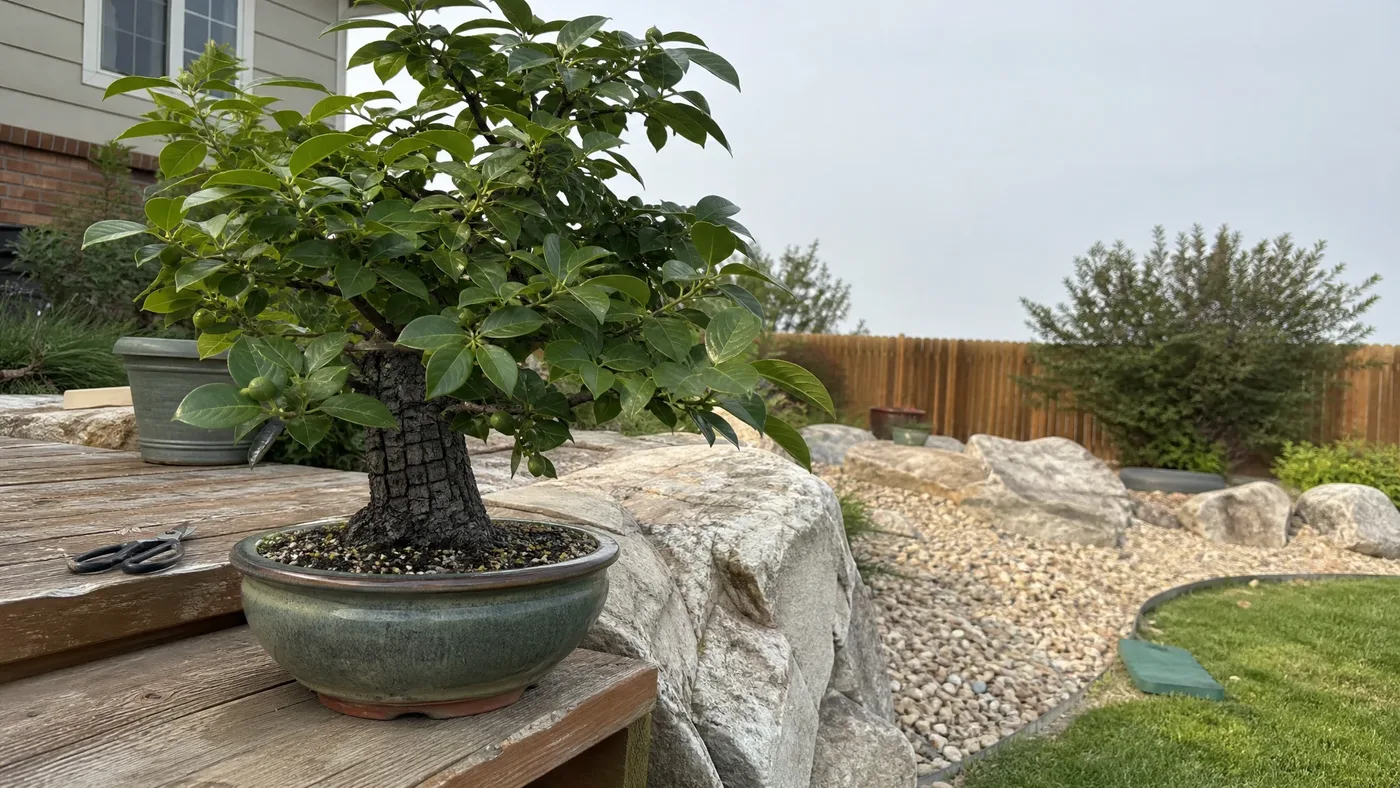
American Persimmon Bonsai: Training and Care Basics
Your persimmon bonsai has leaves the size of your palm, so what went wrong? Nothing, at first. On a full-sized tree, leaves run 2 to 6 inches long and 2 to 3 inches wide, and a small pot does not change that. This is the central problem with the species as bonsai: leaves and fruit stay large while the rest of the tree shrinks.
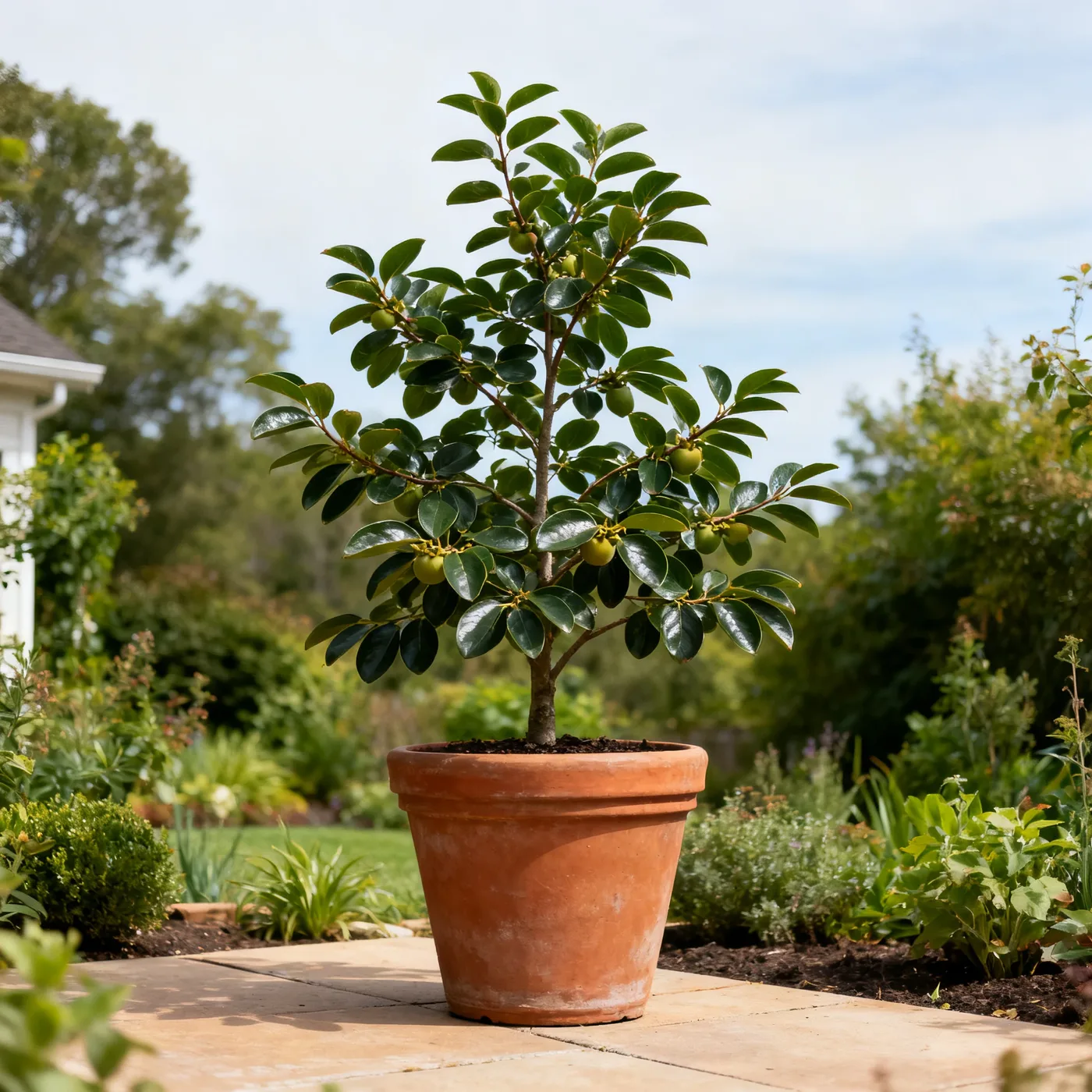
Below, you'll find out all about training American Persimmon in a pot, including the right container, a soil mix that drains, how to bring leaf size down, when to prune and wire, what to do about fruit, and a seasonal set of checks. Done well, you get a compact tree with real fall color. Done badly, you get a stressed, leggy sapling with oversized foliage.
American Persimmon Wants a Deep, Sturdy Pot
Pot choice is the first decision and the hardest to undo, because this species grows a taproot that most bonsai subjects do not have. The pot has three jobs: house that root, hold the tree upright, and drain.
Depth for the Taproot
Illinois Extension lists the species as difficult to transplant due to taproot. That means the shallow tray used for maples and junipers is the wrong start. Begin in a deep pot and step down to a shallower one over several repottings.
Do not cut the taproot flat in one session. What we tell customers is to shorten it in stages, only at repotting, with plenty of fine roots left to feed the tree. Our taproot transplanting guide explains why one big cut sets a tree back.
Weight for Stability
Persimmon leaves are broad, so a leafy tree catches wind like a sail. Pick a heavy stoneware or ceramic pot with large drainage holes, and set it on a bench or low stand that cannot tip.
Light plastic pots work for growing on, but they blow over once the canopy fills in. For general container sizing, see our container growing guide.
Signs the Pot Is Too Shallow
Match the symptom to the fix. If the tree wilts in the afternoon even though the soil was wet that morning, the roots have no room to buffer water, so go deeper. If the pot dries out within a day, it is too small as well as too shallow.
If new shoots are stunted and pale, roots may be coiled against the bottom with nowhere to go. And if the pot rocks when you touch the trunk, add weight or move up a size.
The Soil Must Drain but Still Hold Water
In the ground, American Persimmon is forgiving. It tolerates hot, dry conditions and poor soils, and UF/IFAS lists tolerance of clay, sand, loam, acidic and alkaline soil, including extended flooding as well as well-drained sites. A pot removes that forgiveness.
A pot has no surrounding soil to wick water away or to supply it. The mix has to do both jobs alone. Do not copy a recipe built for a pine or a juniper. Persimmon is a thirsty broadleaf tree with big leaves, and it needs a mix that holds moisture longer than those do. Our soil guide covers amendments in more detail.
Reading the Mix
Neutral soil for this tree runs from 6.0 to 8.0, so you do not need an acidic bonsai blend. Use this table to read what your mix is telling you.
| What you see | What it means | What to do |
|---|---|---|
| Pot is still heavy and wet 2 days after watering | Mix holds too much water | Repot into a coarser blend with more grit |
| Leaves droop and soil is bone dry an inch down | Mix drains too fast or pot is too small | Water more often and add organic matter at repotting |
| Water runs straight off the surface | Top layer has gone hard | Scratch the surface and soak the pot from below |
| Leaf edges brown while soil is wet | Roots are suffocating | Check the drainage holes and the lower roots |
The Finger Test
Push a finger into the mix every morning in summer. If the top inch is dry and the mix below is cool and damp, water. If the whole depth is dry, you waited too long, and you should water twice, a few minutes apart, so the dry root ball takes up the second round.
American Persimmon Leaves Will Not Shrink on Their Own
A small pot limits growth but does not reduce leaf size by itself. The leaf is built to the genetics of a tree that reaches 30 to 80 feet, so you have to reduce it with technique. Two tools do most of the work: light and defoliation.
Give It Full Sun
The tree wants full sun, meaning 6 or more hours of direct sunlight a day. The species tolerates partial shade in the ground, but a bonsai in shade stretches and makes larger, thinner leaves to catch the light. In strong sun, internodes stay short and leaves come in smaller. Turn the pot every week or two so all sides get light.
Defoliate a Strong Tree
Once the first flush of leaves has fully hardened in early summer, cut off the leaf blades and leave the short stalk. The tree pushes a second set that comes in smaller. Do this only to a vigorous tree, and only once a season. If the tree is weak, pale or newly repotted, skip the year.
Also hold back on feeding. Heavy nitrogen produces big, soft leaves, so feed lightly and steadily. Our fertilizing guide gives the general timing.
If the Leaves Come Back Large
Check four things in order. First, light: is the tree getting direct sun? Second, feeding: did you apply too much nitrogen? Third, the pot: is a crowded root ball stressing the tree? Fourth, the calendar: did you defoliate before the first leaves hardened?
Expect improvement over several years as branches become finer. One of the most common questions we get is why leaves stay big after one defoliation. They usually do, and that is normal. Leaf size drops in steps, not in a single season.
Structural Pruning Belongs in Late Winter
Make your main structural cuts while the tree is dormant, in late winter, before the buds swell. You can see the whole branch structure then, and the tree has its stored energy ready to push new shoots below each cut. Our pruning guide covers the full-sized tree, and the same timing applies here.
Cut Above a Bud You Want
Cut just above a bud that points the direction you want the new branch to grow, usually outward and slightly upward. The buds closest to the cut wake first. A long stub will die back and look ugly, so cut close. Seal larger wounds so they do not dry and crack.
Read the Buds That Result
In spring, several buds near each cut will push. Choose one or two and rub off the rest while they are tiny. If you leave them all, the tree makes a cluster of weak shoots instead of one strong branch.
Let the chosen shoots grow a few leaves, then trim back to keep internodes short. If a bud fails to push by early summer, the branch behind it is likely dead, and you can cut back to the next live bud.
Remove any shoots that rise from the roots or the base of the trunk. Mature trees produce root suckers, and a healthy bonsai will send them up too.
Pair Cuts With Repotting
Late winter is also the best time to repot, just as buds start to swell. Prune the top and the roots in the same year only if the tree is strong. If it looks tired, do one or the other.
Wire Gently Because American Persimmon Wood Snaps
Persimmon wood is dense and brittle, so it resists bending and then breaks when forced. Treat every bend as a small adjustment, not a single move. This is the opposite of how you handle a pliable juniper.
Timing and Wire Size
Wire young shoots in the growing season, once they have started to firm up but still flex. Avoid wiring in cold weather, when wood is stiffest. Use the thinnest wire that holds the bend, because heavy wire tempts you to force the branch. Wrap at a steady angle and do not cross wires.
Bend in Small Steps
Support the branch with both hands, thumbs behind the bend, and ease it a little at a time. If you feel resistance, stop and return the next day. Check the wire often, because a growing shoot thickens and the wire will bite into the bark. Remove it as soon as the branch holds its shape.
When a Branch Cracks
If a branch cracks but is still attached, do not bend it further. Close the crack gently, bind it with grafting tape or raffia, and leave it alone for the season. The tissue often knits.
If it hangs by a strip, cut it back cleanly to the nearest bud and use the break to redesign. For branches too stiff to wire, shape them by pruning to a new shoot instead. For a different approach to shaping, see our espalier guide.
American Persimmon Fruit Stays Full-Sized on a Tiny Tree
Fruit does not scale down with the tree. It is a globular berry 1 to 1½ inches long, yellowish to pale orange with a waxy bloom. Next to a trunk the width of your thumb, that is a big fruit.
Will It Fruit at All?
Maybe not. The University of Kentucky notes that male and female flowers are borne on separate trees, so a lone bonsai will not set fruit unless a tree of the other sex is nearby.
Seed-grown trees take 4 to 9 years to fruit, while grafted trees need 3. Flowers open in May and June and are easy to miss.
Let It Set or Remove It?
Use this rule. If the tree is still thickening its trunk or you are building branches, remove the flowers or young fruit. Fruit draws energy that the structure needs.
If the design is set and the tree is vigorous, let one or two fruit ripen. Heavy fruit bends thin branches, so support them with a prop if needed. The fruit is astringent until fully soft, so read our ripening and harvest guide before you taste one.
Seasons Set the Care Schedule
Bonsai care follows the calendar more closely than ordinary pot culture does. Run through these checks as the year turns.
- Late winter: Check the buds, make structural cuts, and repot if the tree needs it before the buds swell.
- Spring: Check that new shoots are not crowded, rub off extra buds, and begin light feeding as growth starts.
- Early summer: Check that the first leaves have hardened, then decide whether the tree is strong enough to defoliate.
- Summer: Check the soil daily in heat, since big leaves lose water fast, and wire new shoots only while they still flex.
- Fall: Check that fruit is not overloading branches, enjoy the color, and stop feeding. UF/IFAS lists fall color as yellow, red and purple.
Winter Protection for the Pot
The species is hardy in the ground in USDA zones 4 through 9. But a pot has little insulation, and roots in a container are far more exposed than roots in the soil. Treat the zone range as a ceiling for the tree, not a promise for its pot.
Move the pot to a sheltered, unheated spot, group pots together, and mulch around them. Do not let the mix dry out completely, since a dormant root still needs some moisture. Ask your local extension service how cold your area gets.
A Trained American Persimmon Rewards Patient Seasons
The rules are short. Use a deep, heavy pot. Keep the mix draining but moist. Give full sun and defoliate only strong trees. Prune in late winter, wire in small steps, and decide on fruit by how finished the structure is. Large leaves and fruit are part of this species, so aim for a balanced tree, not a miniature maple.
American Persimmon
Nursery-grown American Persimmon in sizes from 1 Gallon, shipped to your door.
From $54.95
Shop Now →When the tree looks wrong, check the pot and the calendar first. Most problems come from a pot that is too shallow or a task done in the wrong month. As a small grower with our own farms, we grow and sell top-quality trees, and we care about getting bonsai training right because a persimmon shaped well in its early years gives you decades of healthy growth.