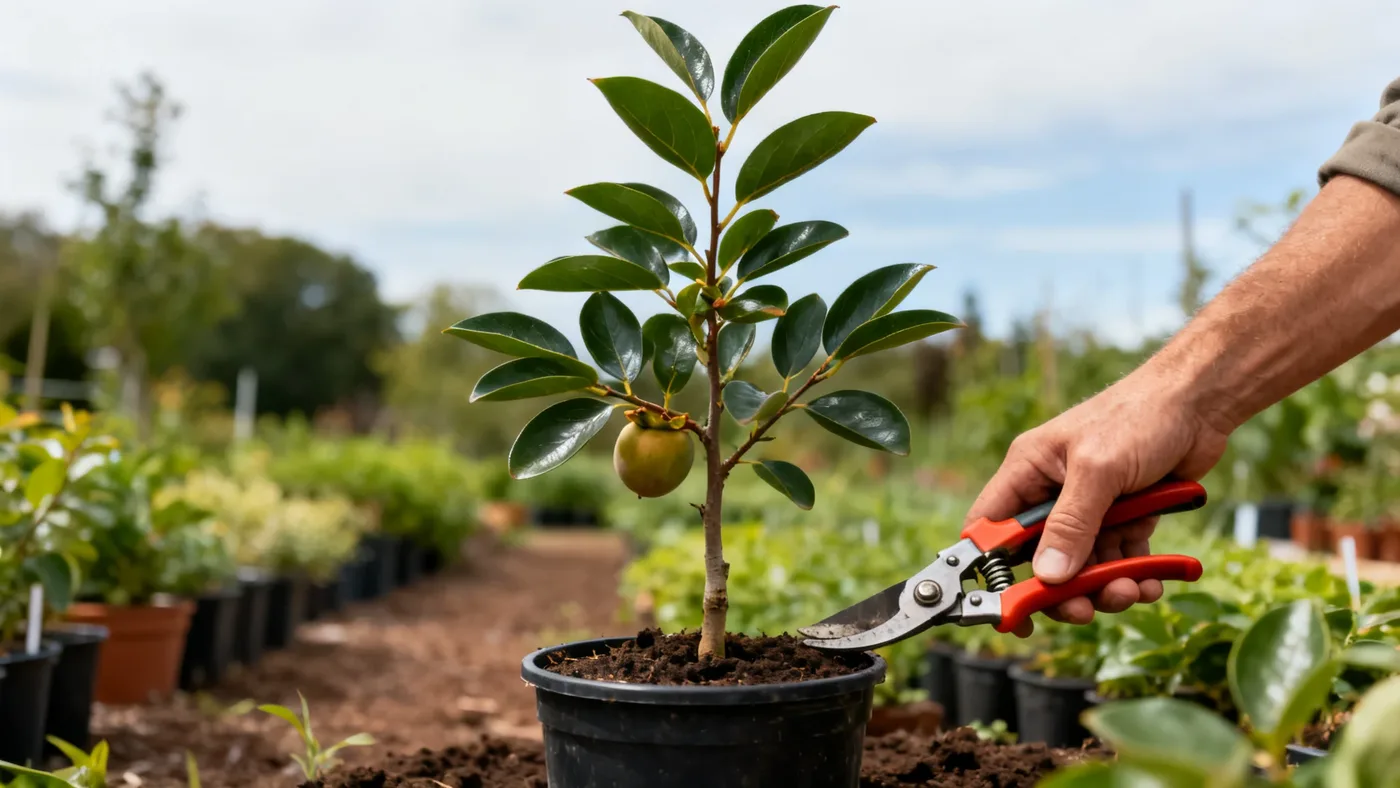
How and When to Prune an American Persimmon Tree
Pruning an American Persimmon tree is straightforward once you know the timing and basic structure. American Persimmons fruit on new growth, which means you can prune with confidence, aggressive pruning won't steal your future harvest. The key is timing: prune in late winter while the tree is dormant, before flowers emerge in May through June.
Why Prune American Persimmons
Pruning serves two main purposes: establishing a strong structure when the tree is young, and removing problem wood as it matures. A well-structured young tree will grow straighter, produce fruit more reliably, and be easier to harvest from later. A mature American Persimmon, which reaches 35 to 60 feet tall and 20 to 35 feet wide at full size, benefits from occasional pruning to remove branches that cross, hang too low, or show signs of disease.
Because American Persimmons fruit on new growth, you do not need to worry that pruning will reduce next year's fruit. In fact, opening up the canopy can help fruit mature more evenly by improving air circulation and light penetration.
When to Prune Your American Persimmon
Timing is critical. Prune only while the tree is dormant in late winter, ideally before buds break in early spring. This is usually January through March, depending on your location. Since American Persimmons bloom in late spring (May through June), you have a comfortable window: prune anytime after the coldest part of winter and before the first visible flower buds appear.
Never prune during the growing season or after flowers have formed. Pruning during active growth wastes energy the tree could direct toward fruiting. Pruning after bloom has begun can remove developing fruit.
Materials You Will Need
- Hand pruners (bypass type, sharp) for branches up to one-half inch diameter
- Loppers for branches one-half to 2 inches in diameter
- A pruning saw for branches thicker than 2 inches
- Pruning paint or wound sealant (optional; American Persimmons heal well without it, but some gardeners prefer it for large cuts)
- Loppers or pole pruner for reaching high branches safely
- Work gloves and safety glasses
- A sturdy stepladder if needed
How to Prune a Young American Persimmon Tree
Young trees (ages 1 to 3 after planting) need structure. The goal is to establish a strong central leader (a single main trunk) and remove competing branches. This foundation determines the tree's shape and strength for decades.
Step 1: Identify the central leader. Look at your tree and choose the most vigorous, straightest upright branch or stem. This will become your main trunk. If your young tree was already planted with a clear central leader, keep it. If multiple stems are competing for dominance, choose the strongest one.
Step 2: Remove competing upright branches. Any other branches growing nearly parallel to your chosen leader are competing for dominance. Using hand pruners, cut these flush with the trunk. Make a clean cut close to the branch collar (the swollen area where the branch meets the trunk), but do not cut into the collar itself. The branch collar contains the tree's natural healing compounds.
Step 3: Select scaffold branches. Once the central leader is clear, choose 3 to 5 well-spaced side branches (scaffold branches) that will form the main framework. They should be:
- Spaced 6 to 12 inches apart vertically along the trunk
- Angled 45 to 60 degrees from the trunk (not straight out or drooping)
- Distributed evenly around the trunk (imagine the points on a compass)
Step 4: Remove everything else. Cut out branches that interfere with your chosen scaffold branches. Remove any branches growing downward, crossing other branches, or crowded together. Do not leave small stubs; these will not develop into useful branches and can harbor pests.
Step 5: Head back the leader if necessary. If your young tree is growing very tall and spindly, you can cut the central leader back by 20 to 30 percent to encourage branching. Make the cut just above an outward-facing bud. This promotes a more compact, branched form.
How to Prune a Mature American Persimmon Tree
Mature trees need minimal pruning since American Persimmons fruit reliably on new growth and the tree's natural shape is attractive. Focus on maintenance and problem wood only.
Step 1: Remove dead or diseased branches. Look for branches that are brown, showing no buds, or have visible cankers (sunken or cracked bark). Cut these back to healthy wood, cutting well into the previous year's growth if needed to ensure you have removed all disease. Diseased branches can spread pathogens throughout the tree.
Step 2: Remove crossing or rubbing branches. Branches that cross each other or rub together create wounds and invite pests and disease. Choose the better-positioned branch and remove the other one completely, cutting flush at the base. Do not leave a short stub.
Step 3: Thin crowded growth. If branches are so dense that you cannot see through the canopy, thin out smaller or less-productive-looking branches to improve air flow. Remove about 10 to 20 percent of the branch mass, no more. Aggressive thinning on a slow-growing tree like American Persimmon can take years to recover.
Step 4: Remove low or downward-hanging branches. If branches hang so low they interfere with mowing or access, remove them. Also remove branches that curve sharply downward and might split under the weight of fruit when laden in fall.
Step 5: Cut back excessively long branches if needed. If a branch is growing well beyond the tree's natural outline and throwing off its balance, cut it back to a healthy lateral branch or bud. Do not top the tree (cut off the top of the main trunk); this is disfiguring and unnecessary for American Persimmons.
Tips for Success
Make cuts at a 45-degree angle just above a healthy bud or branch collar. Avoid leaving stubs, which will not heal properly. A proper cut heals faster than a jagged wound. For large branches (over 2 inches in diameter), use the three-cut method: make an undercut a few inches out from the branch collar, then cut from above to remove most of the branch weight, then finish with a clean cut close to the collar. This prevents bark tearing.
Sterilize your tools between cuts if you are removing diseased wood. A quick wipe with a cloth soaked in 10 percent household bleach or isopropyl alcohol prevents spreading disease to healthy branches. Do this especially when moving from a diseased branch to a healthy one.
Do not remove more than one-third of the tree's total canopy in a single year. American Persimmons grow roughly 12 to 18 inches per year once established, and aggressive pruning slows them further and can shock the tree, reducing flowering and fruiting the following season.
Common Pruning Mistakes to Avoid
Pruning at the wrong time. Never prune in spring after buds break or in summer. This wastes growth energy and makes the tree vulnerable to disease and pest entry through fresh wounds.
Leaving stubs. Stubs do not heal and attract pests and disease. Always cut flush to the branch collar. A stub will gradually die back and can become an entry point for canker-causing fungi.
Over-pruning. American Persimmons do not need heavy pruning. More pruning does not mean more fruit; it just means a smaller tree that recovers slowly. Patience pays off with this species.
Topping the tree. Cutting the top of the main trunk creates multiple weak branches that will eventually split. Avoid this practice entirely. If the tree grows taller than you prefer, wait for it to mature; the natural shape will be more attractive than a topped tree.
Removing healthy branches unnecessarily. Let the tree grow and fill in. Prune only for structure (young trees) or to remove problem wood (mature trees). Unnecessary pruning just delays the tree's development.
What to Expect After Pruning
You may see some branch die-back along cuts, especially on older wood; this is normal and the tree will compartmentalize the wound. Wounds on American Persimmons typically close over within one to two growing seasons without sealant, though large cuts may take longer to fully heal. Do not expect the wound to disappear entirely; the tree will form callus tissue around the cut.
A young tree pruned to establish a central leader should show visible improvement in shape and sturdiness by the following year. Growth will be more upright and branched. A mature tree pruned to remove deadwood or improve airflow should show no decline in fruit production; if anything, fruit quality may improve with better light and air movement through the canopy.
For more on caring for your American Persimmon year-round, including watering, soil, and feeding, see our American Persimmon care guide.
Pruning Quick Reference
| Timing | Tree Age | What to Prune | Goal |
|---|---|---|---|
| Late winter (Jan-Mar), before buds break | Young (1-3 years) | Competing leaders, scaffold branches selected, crossing branches | Establish strong central leader and balanced framework |
| Late winter (Jan-Mar), before buds break | Mature (4+ years) | Dead, diseased, crossing, or low-hanging branches | Remove problem wood and improve airflow |
| May-June onward | Any age | Nothing (avoid pruning) | Allow flowering and fruit development to proceed |
| Any season if urgent | Any age | Branches posing a safety hazard only | Safety; defer routine work until late winter |