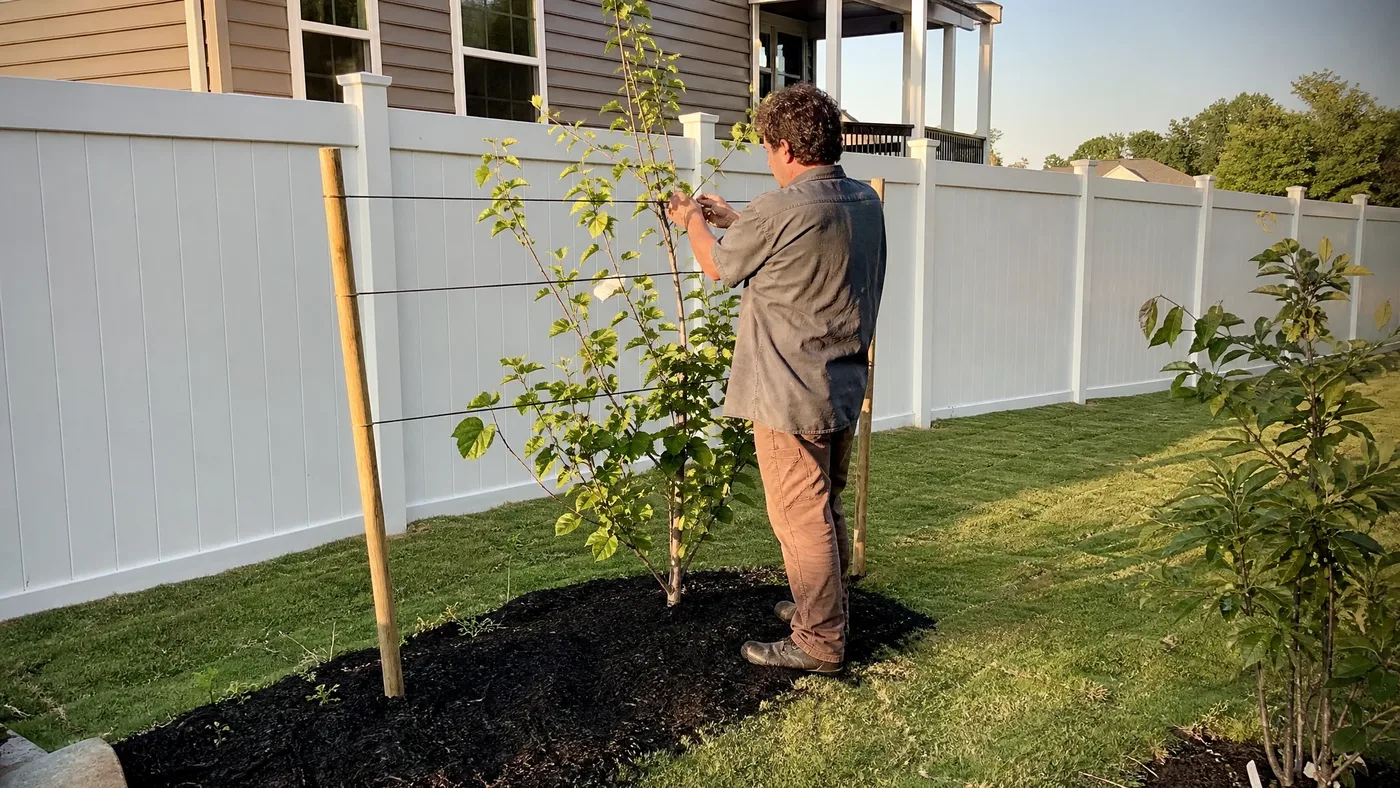
How to Espalier an American Persimmon Tree
This tree was not built to be flat, and the wall will not change its mind. American persimmon wants to be an upright oval with a deep taproot below it and one leader pushing for the sky, and every spring it will try to turn your tidy wire grid into a ladder.
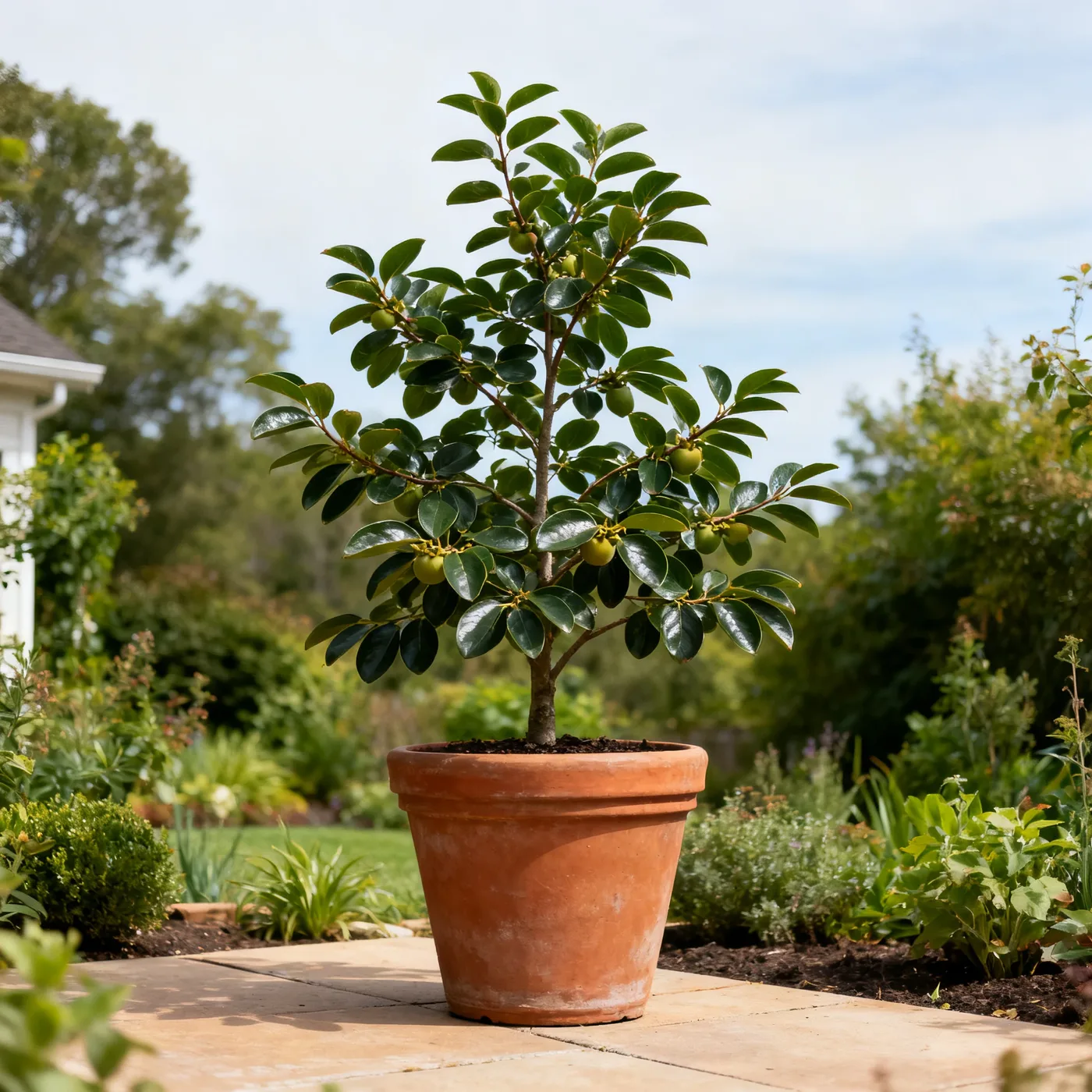
Get the training wrong and you get snapped limbs, a lopsided frame and a wall of flowers with no fruit behind them. Get it right and you get a flat, slow, handsome tree that carries fruit on a narrow strip of wall.
We'll walk you through how the tree grows and why it resists, then how to bend its brittle wood, steer the leader, plan a pair for fruit, build the frame, plant and tie in, and prune each summer to hold the shape.
How American Persimmon Grows and Why It Fights You
Training only works if you know what you are pushing against. Three traits decide how hard this job is: the root, the leader and the size the tree is built to reach.
A Taproot That Fixes Your Site
The root comes first, because it settles where the tree can go.
American persimmon sends down a deep taproot, and NC State points out that this makes it difficult to transplant. For an espalier that means you choose the spot once. Move a tree after two seasons of training and you lose the roots and the frame together. Our piece on why the taproot matters explains the cost, so pick a wall with deep, open soil at its foot and commit to it.
Mature trees also send up root suckers, which can become a weed problem. Against a wall they pop up in the bed or lawn in front, and you will be cutting them out for as long as the tree stands.
A Leader That Never Stops
Above ground, the growth habit is the real fight.
The species reaches 40 to 60 feet according to UF/IFAS, and nearly all of that height comes from one dominant tip. The top shoot grows hardest while the side branches below it stay short and weak. That is strong apical dominance, and espalier asks for the opposite: even strength in every horizontal arm.
Every cut and every bend in this guide exists to move vigor from the tip to the sides. The growth rate is only moderate, which is a mercy, because it gives you time to correct mistakes. Apples and pears cooperate readily. Persimmon has to be talked into it, repeatedly.
Brittle Wood Means Slow Bending
Young American persimmon wood is stiff, and a branch forced down in one move tends to crack at its base instead of curving. Build your whole bending routine around that.
Common advice for apples says to pull a shoot to horizontal and tie it down. Do not do that here. A persimmon shoot forced flat in a single go usually splits at the joint, and a split like that rarely heals into a good arm.
Bend in Warm Weather Only
Timing matters as much as technique with wood like this.
Work during the growing season, with leaves on and warm air around the tree, when shoots flex most. We often see cracked limbs that were bent on a cold morning. Skip windy days too, because a gust can finish what a gentle tie started.
The Step-by-Step Bend
Lower each shoot in stages over several weeks, never in one session.
- Tie the shoot loosely to a bamboo cane fixed along the wire, so it is supported along its length and not just at the tip.
- Pull it down only until you feel resistance, then tie it there with a soft tie. Do not chase the wire.
- Come back about once a week, drop it a little lower and retie. Stop for the day the moment the wood creaks.
- Hold the shoot with your free hand just beyond the joint while you tie, so the strain goes into your hand and not the crotch.
- Leave the arm at horizontal for the rest of the season before you remove the cane.
If a limb cracks but still hangs by a strip of bark, bind it snugly to a cane and leave it alone. Some mend and some do not, so keep a spare shoot nearby as a replacement.
Taming a Leader That Wants to Climb
The leader is both your trunk and your opponent. You need it to build each tier, then you have to stop it going any higher.
The University of Kentucky says the species grows into an upright oval 40 to 50 feet tall, and that is the shape you are working against. Typical apple and pear espaliers have three or four tiers. We say stop at three on a persimmon, because every extra tier is another leader you have to hold back.
Build One Tier at a Time
The method is the usual one, but this tree punishes shortcuts.
- At planting, cut the whip just above a bud at the first wire. Three shoots will grow from the buds below the cut.
- Keep the strongest as a vertical new leader and tie it straight to a cane. Lower the other two, one to each side, using the slow bend from the last section.
- The next season, cut the leader just above the second wire and repeat. Take the same three shoots and do the same thing.
- If one arm lags behind the other, leave it more upright until it catches up, then lower it. The leader will always favor itself, so do not let side arms fall behind it.
Capping the Top
Once the top tier is in place, the leader has to be stopped for good.
Cut it off just above the top wire. The tree will answer with a cluster of vigorous upright shoots at the cut, because that is what a dominant tip does when it loses its end. Pinch most of them out while they are soft and keep only what you need to fill the arms. Expect this every summer.
Two Sexes, One Wall: Planning Your Pair
This is the part of espalier that apples and pears never make you think about. A flat tree of the wrong sex is just a flat tree with no fruit.
Persimmons are usually dioecious, with separate male and female trees, and you need both to get fruit. Some trees do have perfect flowers, which is the loophole a wall gardener wants. The flowers are slightly fragrant, not readily obvious and open from May to June, so you cannot read a young tree's sex at a glance.
The Self-Fertile Route
Choose this if your wall has room for one tree only.
Ask for a named, grafted cultivar sold as self-fertile, and get that in writing from the seller. Our list of American persimmon cultivars is a good place to start. Avoid a seed-grown tree on a wall. It can take 4 to 9 years to show what it is, and by then it has taken up wire space you cannot get back.
The Pair Route
If you want a true female crop, plan the male at the start and put both on the wall.
Set two trees side by side, each on its own run of wire. The male only has to flower, but trained flat it stays in scale and earns its place as an ornamental. Budget wall length for two trees, and add margin, because persimmon will outgrow any box you draw. Keep the pair close together on the same wall, in the same light.
Building the Wall Frame and Wire Grid
Build the frame before the tree arrives. The wires carry the weight of every tier, and adding them around a planted tree means working around brittle wood.
Apple and pear espalier wires are typically spaced 14 to 18 inches apart, with the first wire 16 inches off the ground. We use the same grid for persimmon and lean toward the wider end, because thick, stiff arms need elbow room and a wide gap leaves space for the slow bend. Three tiers put the top wire at roughly four feet.
Frame Checklist
Run through these points before you buy a single wire clip.
- Use heavy galvanized wire tensioned between sturdy eye bolts or posts, since a persimmon arm gets heavy and a sagging wire ruins a level tier.
- Hold the wires a few inches off the wall with standoffs, so air moves behind the tree and the trunk has room to thicken.
- Choose a sunny wall. The tree wants full sun, meaning six or more hours of direct light, and tolerates partial shade, but a flat tree has little canopy to spare.
- Leave bare ground or mulched soil in front of the wall, not pavement, for the taproot to run and for you to pull suckers.
- Size the grid for the pair if you are planting a male and a female, with extra room at each end.
Setting an American Persimmon Against the Wall
With the frame up, planting day is short, but the first cuts and the first ties set the tree's habits for years.
Planting Day
Follow our planting guide for the hole, the backfill and the watering, and add the wall-specific points here.
Plant the single stem just in front of the lowest wire, as is usual for apple and pear, and stand it a few inches out from the wall. Dig deep rather than wide, and set the roots without bending the taproot. This tree is staying where you put it.
The First Cuts
Resist the urge to leave the tree full length for a year.
Cut the whip just above a bud at the height of the first wire, as laid out in the tier steps above. That cut is what forces the three shoots that become your first tier. After that, leave it alone until the shoots are ready for their first bend.
Tying In
Ties are the quiet cause of most wall damage, so use them carefully.
Use soft, wide ties in a figure-eight between stem and wire, so the stem cannot rub the metal. Leave room for the wood to swell. In our rows, the most common damage we see is a tie left on until it bites into the bark. Check every tie at least once a season and replace any that have gone tight.
Summer Pruning on a Flat American Persimmon
A flat tree stays flat only if you cut it back every year. Plan the work around the growing season, when the wood is flexible and the tree can recover.
Established apple and pear espaliers are pruned every year in late summer, when growth slows. We follow the same rhythm for persimmon, and our guide on routine persimmon pruning covers the standard cuts that apply to a free-standing tree. Here is what to look for on the wall.
Walk the wall with sharp bypass pruners and sort what you see by this table.
| What you see | What to do |
|---|---|
| Shoots pointing out from the wall or straight back into it | Cut back to a few leaves to keep the frame flat. |
| Vertical shoots from the tops of arms | Remove them, or tie one in if it fills a bare gap. |
| Regrowth above the top wire | Cut it off at the source so the leader cannot rebuild. |
| Root suckers at the base | Cut them as low as you can, below the soil if possible. |
| A bare patch on an arm | Tie in a nearby flexible shoot to cover it. |
Keep your cuts light and frequent. One hard cut wakes up the dominant buds and gives you a thicket to sort out next year.
A Flat American Persimmon Takes Years, Not Weeks
Plan on several seasons to build the three tiers, and treat the fruit as a late reward. Fruiting time is 3 years for a grafted tree and 4 to 9 for a seed-grown one, and training will not speed that up. Once the frame is full, your summer work shrinks to a light annual tidy-up, and you get the yellow, red and purple fall color that UF/IFAS describes, laid flat against the wall.
American Persimmon
Nursery-grown American Persimmon in sizes from 1 Gallon, shipped to your door.
From $54.95
Shop Now →Patience is the whole technique, and the first fruit on the wall is its only receipt. We are a small business raising top-quality trees on farms of our own. Before a plant leaves us, we check the roots, the straightness of the stem and the strength of the leader, because those are the parts an espalier leans on for years.