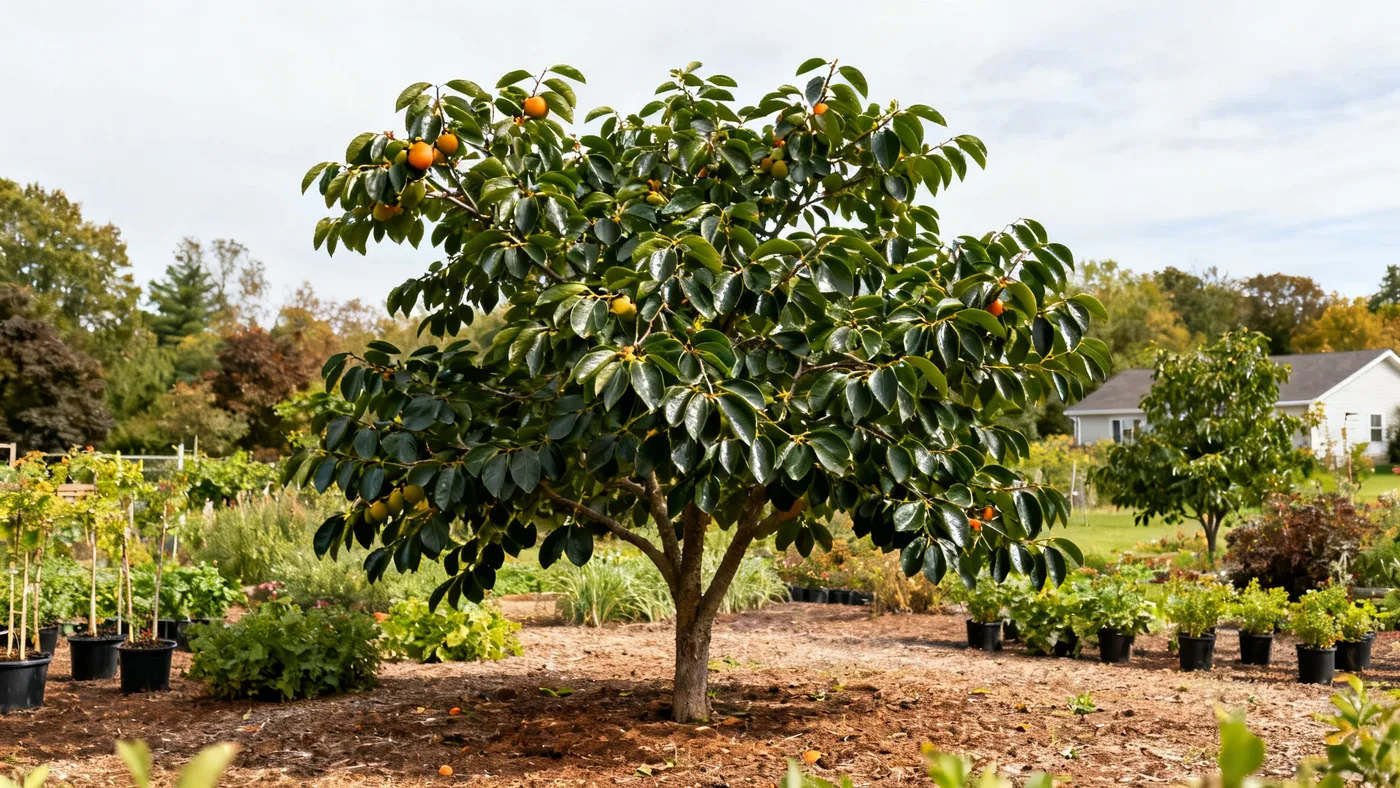
Best American Persimmon Varieties and Cultivars to Grow
American Persimmon (Diospyros virginiana) has been eaten and cultivated for centuries, yet most home growers simply plant what's available at the local nursery. The reality is that not all persimmons are created equal. Some cultivars take a decade to fruit, while others can produce edible harvests within 3 to 5 years. Some trees require a male pollinator nearby; others are self-fertile and reliably productive on their own. Choosing the right American persimmon variety makes the difference between a decade of waiting and a rewarding food-producing landscape.
The cultivars listed here represent selections that have proven reliable for home gardeners and small-scale growers. Each brings something different to the table: earlier ripening, larger fruit, self-fertility, or exceptional flavor. Understanding the traits of these American persimmon cultivars will help you pick the one that fits your climate, space, and patience level.
1. Meader Persimmon: The Parthenocarpic Powerhouse
Meader is the gold standard for home gardeners who want reliability without complexity. This American persimmon cultivar is self-fertile, meaning it produces fruit reliably without requiring a male tree nearby. In horticultural terms, Meader exhibits parthenocarpy, a trait that allows the tree to set fruit even if pollination never happens. For a home grower in zones 4 through 9, this eliminates one of the most common frustrations with American persimmons: planting a female tree only to discover years later that it needs a pollinator to fruit.
Meader reaches maturity relatively quickly within the American persimmon timeline. Grafted Meader cultivars often produce their first fruit between 3 and 5 years after planting, significantly faster than seedling trees, which typically take 6 to 10 years. The fruit is medium-sized, high in sugar, and fully astringent when unripe. One of the most important lessons with any American persimmon variety is that unripe fruit will leave your mouth dry and puckered. Meader must fully ripen, until the skin wrinkles and the flesh yields to light pressure, before it becomes the sweet, almost date-like treat that makes this species worth growing.
Meader thrives in full sun and average to moist, well-drained soil. It adapts to a wide range of soil types including clay, loam, and sandy soils. Once established via its deep taproot, it becomes drought tolerant, a trait that sets American persimmons apart from many ornamental trees. This self-fertile cultivar is the practical choice for most home landscapes: no pollinator required, faster to first fruit, and proven flavor.
2. Prok Persimmon: The Prolific Producer
Prok is another premium American persimmon variety that deserves consideration, especially for growers who want heavier yields year after year. This cultivar carries a reputation for consistent and abundant cropping, making it a favorite among those who plan to harvest persimmons regularly rather than just enjoy an occasional fruit. Like other American persimmon cultivars, Prok produces clusters of creamy white to pale yellow-green flowers in late spring (typically May to June), though these flowers are not showy and have only a mild, sweet fragrance.
The practical benefit of choosing Prok is that it sets and holds more fruit than many wild-type American persimmons. Fruit drop before ripening is a common problem on standard American persimmon trees, but Prok has been selected for more reliable retention. The fruit ripens mid-to-late in the season, so Prok extends your harvest window if you plant it alongside an earlier-ripening variety. This is particularly useful in shorter growing seasons or if you want to stagger ripe fruit availability.
Prok requires a male pollinator or another male-type tree for reliable fruiting, so this cultivar is best suited for growers who either have space for two trees or are planting into an orchard setting. When you're ready to plant, choose a location with full sun (the best fruiting occurs in full sun, not part shade) and space the trees 20 to 35 feet apart to account for the mature spread of 20 to 35 feet. Prok's growth rate is slow to moderate, with trees adding roughly 12 to 18 inches per year once established.
3. Early Golden: Harvest Before Frost Arrives
Early Golden lives up to its name, ripening several weeks earlier than most American persimmon varieties. For growers in zone 4 or at the edge of the American persimmon's hardiness range, an early-ripening cultivar can be the difference between a harvest and an early freeze that ruins the fruit. Early Golden typically reaches full ripeness in mid-fall, giving you time to collect soft, ripe fruit before cold weather sets in or before the ground becomes too hard to forage beneath the tree.
This cultivar produces medium-sized fruit with good sweetness once fully ripe. Like all American persimmons, the fruit is astringent when unripe and must be eaten soft. The practical advantage of Early Golden is that it fits growers with shorter growing seasons or those who want to minimize the overlap between ripening fruit and the first hard frosts. Nursery-grown Early Golden trees sold in quart, #1, or #3 containers can be planted in early spring or fall while dormant, allowing you to establish the tree before the growing season accelerates.
For care and establishment, follow the guidelines in our American persimmon care guide, which covers sun exposure, soil preparation, and pruning fundamentals. Early Golden benefits from the same adaptable soil conditions as other American persimmons, though it performs best in well-drained soil that is neither waterlogged nor extremely dry.
4. Szukis Persimmon: A Distinct Alternative
Szukis is a named cultivar that offers a different profile from Meader and Prok. This variety produces medium to large fruit and is valued for its flavor and texture. Szukis represents the range of genetic diversity within American persimmon cultivars, each with slightly different ripening dates, fruit size, and productivity patterns. Home growers who want to experiment beyond the most commonly available varieties will find Szukis worth seeking out from specialty nurseries.
Like other American persimmon cultivars, Szukis requires attention to pollination. It is not self-fertile, so you will need to plant a male American persimmon tree or rely on wild trees in the area to provide pollen. For growers establishing a small fruit orchard or food forest, combining Szukis with a self-fertile cultivar like Meader creates a complementary system: the Meader guarantees fruit even without additional pollinators, while Szukis adds diversity and potential for higher yields if cross-pollination occurs.
Szukis reaches its full height and width like other American persimmons, maturing to 35 to 60 feet tall and 20 to 35 feet wide over many decades. The lifespan of American persimmon trees is impressive, commonly 75 years or longer, making Szukis a long-term investment in your landscape.
5. Yates Persimmon: Steady Performance
Yates is another established cultivar in the American persimmon market. It produces reliable crops and has been grown by home gardeners and small orchardists across the native range of American persimmons, from Connecticut south to Florida and west to Kansas and Texas. The Yates cultivar fits within USDA zones 4 through 9, the full hardiness range for American persimmon species.
This cultivar requires a male tree for consistent fruiting and ripens mid-to-late in the season. Yates pairs well with earlier-ripening varieties to spread your harvest across several weeks. It also pairs well with self-fertile cultivars like Meader if you want insurance against a poor pollination year. Understanding your watering needs is especially important with any American persimmon variety, and our guide to watering young versus established trees will help you time irrigation correctly during establishment and droughts.
Yates is a solid workhorse cultivar for growers who prioritize steady production over flash and novelty. It rewards proper siting (full sun, well-drained soil) with predictable fruiting once the tree matures.
Quick Reference: American Persimmon Cultivars at a Glance
| Cultivar | Self-Fertile | Years to First Fruit | Ripening Time | Best For |
|---|---|---|---|---|
| Meader | Yes (parthenocarpic) | 3-5 years (grafted) | Mid-to-late fall | Home growers wanting no pollinator requirement |
| Prok | No (needs pollinator) | 3-5 years (grafted) | Mid-to-late fall | Prolific crops; orchard settings |
| Early Golden | No (needs pollinator) | 3-5 years (grafted) | Early fall | Short growing seasons; zones 4 and northern zone 5 |
| Szukis | No (needs pollinator) | 3-5 years (grafted) | Mid fall | Specialty growers; flavor diversity |
| Yates | No (needs pollinator) | 3-5 years (grafted) | Mid-to-late fall | Steady production; tried-and-true choice |