How to Identify an American Persimmon Tree in the Wild
Can you name an American persimmon without any fruit on it? Yes. Read the bark, check how the leaves sit on the twig, and you can be right in a few minutes, in any season.
Getting the name right matters. A wrong ID sends foragers back to the wrong tree for fruit that never comes, and it leaves new owners caring for a plant they have misjudged.
This guide covers everything you need to know about identifying American Persimmon, from the four-step field check and the blocky bark to leaves, twigs, flowers, fruit and the look-alikes, Texas persimmon included. Each section gives you a trait to test, so you can walk up to a tree and settle it.
A Quick Field Check for American Persimmon
Start here if you are standing in front of a tree right now. Four checks, done in order, settle most cases. The sections after this one explain each check and what to do when the answer is unclear.
The Four-Step Check
Work through these in order. If any step fails, look at the tree again before you go on.
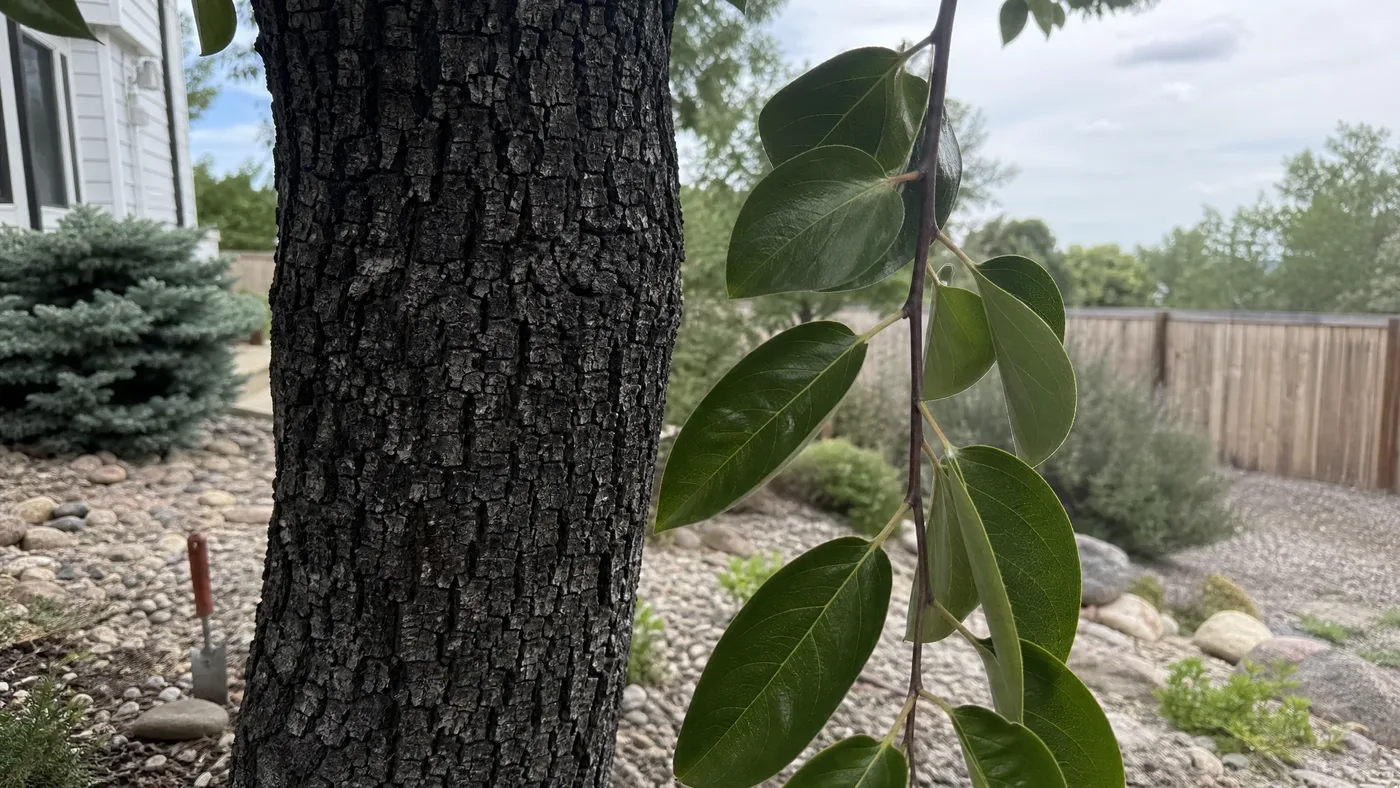
- Look at the trunk. Find dark brown to gray bark broken into small, squarish blocks, with orange showing in the cracks between them.
- Pick a leaf and run a finger around the edge. A persimmon leaf is simple, one blade on one stalk, and the margin is smooth with no teeth.
- Check how the leaves attach. They sit alternately along the twig, one at a time, never in facing pairs.
- If fruit is hanging, measure it. Look for a rounded fruit about 1–1.5 inches across, colored yellowish to orange to red.
Three yeses on bark, leaf edge and leaf arrangement make a strong match. Fruit is a bonus, not a requirement.
Who This Check Suits
The quick check suits foragers who want to confirm a tree before a return trip, and new tree owners who inherited a tree and never learned its name. It works best inside the plant's hardiness range, which NC State Extension gives as USDA zones 4a through 9b.
Outside that range, treat your ID with extra caution and read the look-alike section below. Our guide to the native range, history and naming of the species shows where wild trees are most likely to turn up.
Why We Start With Bark, Not Fruit
Many guides tell you to start with the fruit. We don't. Only female trees carry fruit, and it is gone from the tree for much of the year.
Bark is on every tree in every month. Customers usually ask us whether they can name a tree in winter, with no leaves and no fruit. You can, and the bark does most of the work.
Reading the Bark of American Persimmon
The bark is the feature that sets this tree apart from most of its neighbors. Once you have seen it, you will spot it again from across a field.
What Mature Bark Looks Like
Older trees have dark brown to dark gray bark, deeply furrowed into small blocky plates cross-checked with orange. People often call it alligator skin, and the name fits. The surface looks like a field of small dark tiles.
The orange is the detail to look for. Press your eye close and look down into the furrows. The color sits in the cracks, not on the faces of the blocks, so a trunk in shade can hide it until you get near.
Bark That Does Not Peel
The bark is not exfoliating. Nothing curls, flakes off in sheets or hangs in strips. If the trunk in front of you is shedding bark, you do not have an American persimmon.
Run your hand over a block. It should feel hard and fixed, with deep grooves between plates. Loose scales that come away in your fingers point to a different tree.
Where to Look on the Trunk
Check the lower trunk at chest height first, where the pattern is most developed. Higher up, on limbs and on the upper trunk, the plates get smaller and shallower, so a first glance at a branch can mislead you.
Look at more than one side of the trunk. Moss, lichen or ivy can cover the bark on the shaded side and hide the blocks. Step around the tree, and brush a small patch clear if you must.
Young Trees and Branches
The blocky pattern is described for older specimens. A young trunk will not look like the photographs, and a sapling can have smoother bark with no real blocks yet.
Do not rule out a small tree on bark alone. Fall back on the leaf and twig checks in the next section, and look for a mature persimmon nearby, since a young tree often stands close to a larger one. One leaf is never enough. We often see people judge a tree by a single odd leaf, so check several.
Leaves and Twigs of American Persimmon
Leaves confirm what the bark suggests, and twigs carry the ID through winter. Three traits matter: shape, arrangement and edge.
Leaf Shape and Edge
The leaves are alternate, simple, elliptic to ovate, with entire margins. In plain terms, each leaf is a single oval blade that is widest near the middle or toward the base, with a smooth edge all the way round.
Smooth edges are your fastest rule-out. A leaf with teeth, notches or lobes is not American persimmon, whatever the bark looks like.
Arrangement on the Twig
Look at where leaves join the twig. On a persimmon they alternate, stepping up the stem one at a time. If two leaves emerge from the same point on opposite sides, move on to another species.
Check this on a few twigs at different heights. Alternate arrangement is a reliable mark because it does not change with leaf size or sun exposure.
Winter Twigs
In winter, look at the twigs. They are brown to gray, round in cross-section, about a tenth of an inch thick, and often zig-zag from bud to bud. Small pale dots, called lenticels, speckle the surface.
A zig-zag twig on a tree with blocky bark is a good winter match. Add the bark, and you can confirm a bare tree with confidence.
Fall Color as a Clue
Fall color is variable, so use it only as supporting evidence. UF/IFAS lists the fall color as yellow, red and purple, and NC State adds gold, orange and burgundy tones. Trees in the same grove can turn different colors, so do not reject a tree because it differs from its neighbor.
Use the season to decide which trait to lean on. In summer, test the leaf edge and arrangement. In fall, add color and any fruit. In winter, rely on bark and twigs. In spring, look for the small flowers under the new leaves.
Flowers and Fruit of American Persimmon
Flowers are easy to miss. Fruit is easy to see but only on part of the trees. Know what to expect from each so you do not read their absence as proof of anything.
Flowers in Late Spring
The tree blooms from May to June, and UF/IFAS describes the flowers as white to greenish white. They are small and tucked under the leaves, so you may walk past a tree in full bloom.
The University of Kentucky notes that the flowers are slightly fragrant, thick petalled and not readily obvious, with male and female flowers on separate trees. Look closely at the branch undersides, and do not expect showy blossom.
Why One Tree Has Fruit and Its Neighbor Does Not
Because the sexes grow on separate trees, a healthy persimmon with no fruit is not a mistaken ID. It may be a male. A female with no male nearby may also set little or no fruit.
That is the second reason we do not lead with fruit. A tree without it can still be a persimmon, and our guide on how many years until an American persimmon fruits covers the wait for young trees.
The Fruit Itself
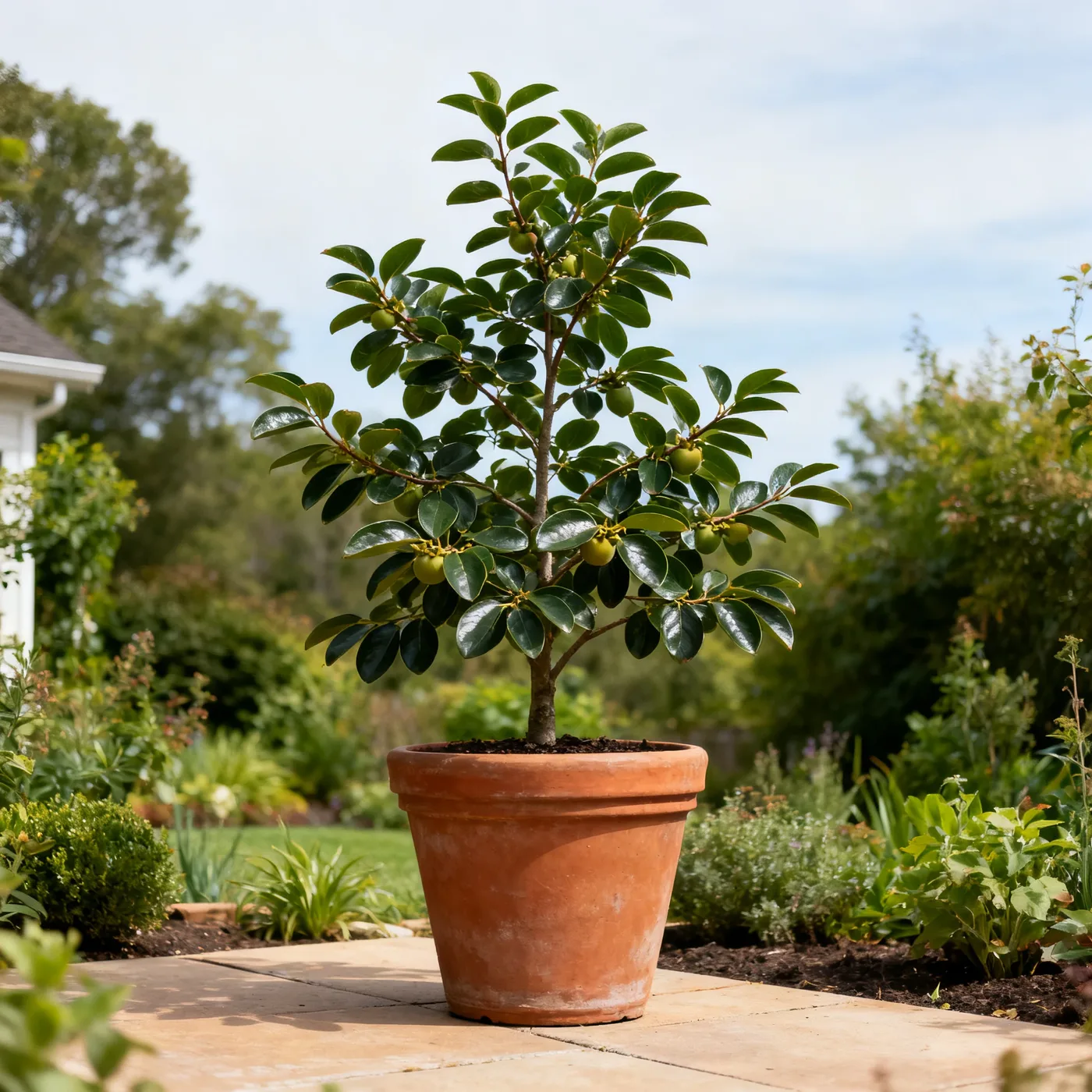
Once a female tree is carrying fruit, the check is simple. The fruit is rounded, 1–1.5 inches in diameter, yellowish to orange to red. Think of a small globe, closer to a large plum than an apple.
Color varies from tree to tree and by ripeness, so judge the shape and size first. For ripeness, astringency and picking, see our guide to American persimmon fruit before you taste anything.
American Persimmon Versus Texas Persimmon and Other Look-Alikes
Texas persimmon shares the genus and part of the name, so it is the most common source of confusion. The table below sets the two side by side, using the traits you can check in the field.
| Feature | American Persimmon | Texas persimmon |
|---|---|---|
| Bark | Dark, blocky plates with orange in the cracks, not peeling | Smooth, mottled gray, peeling |
| Habit | Tree, 30–80 feet tall | Usually a multistemmed shrub or small tree around 10 feet, occasionally to 40 feet |
| Leaves | Elliptic to ovate, smooth edges | Oblong to obovate, about ¾–1½ inches long, paler and hairy beneath |
| Ripe fruit | 1–1.5 inches, yellowish to orange to red | About 1 inch, black when ripe |
Telling Texas Persimmon Apart
Oregon State's plant database describes Texas persimmon as deciduous to semi-evergreen, generally about 10 feet tall, with smooth, mottled, peeling bark. That is the opposite of the American persimmon's tiled trunk.
The leaves are small and hairy underneath, and the fruit ripens black. If your tree is a multistemmed shrub with pale peeling bark and black fruit, it is not American Persimmon.
Other Dark-Barked Trees
Plenty of other trees have dark, furrowed bark, so bark alone never closes the case. Use leaves as the tie-breaker. A look-alike with toothed or lobed leaves, or with leaves growing in opposite pairs, is out.
Fruit helps too. If you find a fruiting tree, compare its size and color with the 1–1.5 inch range above. A tree that passes bark, leaf edge, leaf arrangement and twig is almost certainly the one you want.
American Versus Asian Persimmon
If your tree stands in a yard, it may be a cultivated Asian persimmon instead of a wild native. Our guide to American versus Asian persimmon sets out the differences. When in doubt about a planted tree, ask the person who planted it or check with your local extension office.
Naming Your American Persimmon Tree With Confidence
Confirm the tree in this order: blocky, non-peeling bark with orange in the cracks, smooth-edged alternate leaves, zig-zag twigs, then fruit if there is any. Treat a missing fruit crop as neutral, since male trees never bear. Once you know what you have, our guide to how big an American persimmon gets is a good next read.
American Persimmon
Nursery-grown American Persimmon in sizes from 1 Gallon, shipped to your door.
From $54.95
Shop Now →Our growers watch American Persimmon through the year, from bare bark and zig-zag twigs in winter to late-spring blossom and fall fruit color, and that is why we trust those same signs for naming a tree. We are a small business with our own farms, growing and selling top-quality trees.